I like to refer to my research field with the phrase ultrafast and ultrasmall. I am interested in the electronic structure and the interaction with light of many-electron systems. I study atoms, molecules, clusters, and condensed matter, i.e., my research regards all sorts of ordinary matter. I have devised and used a varied set of methods that are applicable to systems from atoms to crystals.
|
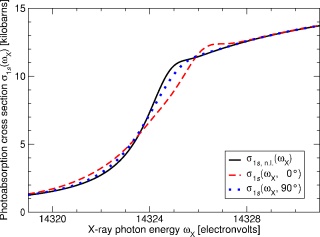
| Fig. 1: Laser-dressed krypton probed by x rays around the K edge. Three cases are shown: without laser, with parallel laser and x-ray polarizations, and with perpendicular polarizations |
Laser-dressed atoms probed by x rays: I am interested in light-matter interaction; particularly if the light originates from strong lasers and/or x-rays. In recent work, we studied laser dressed neon and krypton atoms which are probed around the K edge with x-rays [Fig. 1]. Therefore, we devised an ab initio method. We find electromagnetically induced transparency (EIT) to occur in this setting for x-rays.
Selected publications:
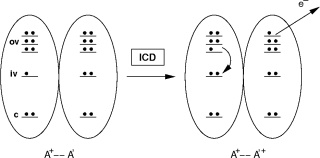 |
| Fig. 2: Interatomic Coulombic decay (ICD). An initial inner valence hole is filled by a valence electron from the same atom. The released energy is transmitted to a valence electron of a neighboring atom which is ejected. |
Interatomic electronic decay processes: We study the decay of electronic Auger-type resonances in xenon fluoride (XeFn, n = 0, 2, 4, 6) molecules. Experimentally an anomalous increase of the decay width of the Xe 4d hole is observed with increasing number of fluorine ligands. We show that this observation can be understood in terms of four interatomic electronic decay processes which overcompensate the loss in intraatomic electronic decay width on the central xenon atom. The processes are: interatomic electronic decay (ICD) [Fig. 2], two-atomic electron transfer mediated decay (ETMD2), and three-atomic electron transfer mediated decay (ETMD3).
X-ray absorption by laser-aligned molecules: X-ray absorption by molecules is studied which are aligned by an intense optical laser. This is a so-called two-color (laser plus x rays) rotational-electronic problem. The interaction with the laser is assumed to be nonresonant. X-ray absorption is approximated as a one-photon process. Our theory opens up novel perspectives for the quantum control of x-ray radiation.
Selected publications:
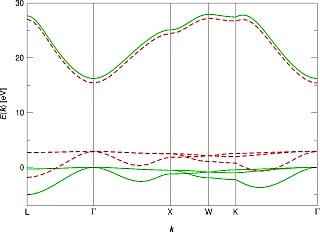 |
| Fig. 3: Hartree-Fock and quasiparticle band structure of a lithium fluoride crystal. |
Excited states: We have devised an ab initio theory to compute the correlation effects for excited states in semiconductors and insulators. The approach is based on a local description of the correlation effects, using Wannier-type Hartree Fock orbitals as a starting point. Subsequently, the self-energy and Green's function are constructed in this basis. A good overall agreement with experiments is achieved in exploring applications. The present work focusses on quasiparticle band structures but strong correlations are amenable, too, with the method and represent an intriguing perspective for future research.
Selected publications:
 |
Private Homepage | Physics Research Homepage |
 Dr. Christian Buth
[homepage @ christianbuth.name]
Dr. Christian Buth
[homepage @ christianbuth.name]